Author: Anastasia

  • “Books that have formed society” – Ben McCabe

    “Books that have formed society” – Ben McCabe

    Watch the full interview here

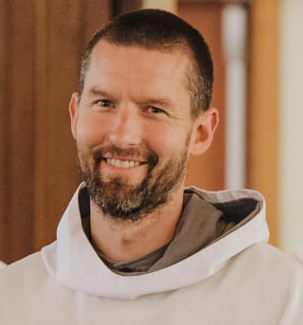
    Ben McCabe founded Augustine Academy in 2016, after completing his liberal arts degree, and while pursuing postgraduate studies. He wanted “to give back some of the education that’s been so formative to me.” Over the past 10 years, he has taught hundreds of students, from every state in Australia and even a couple of Kiwis.

    The core subjects are Theology, philosophy, history, and literature, which are taught along with public speaking, grammar, logic, rhetoric, drama, and agriculture. While some adventurous students come for the outdoor activities, others come for the classical education, and some are drawn to both. Around 85% of students are homeschoolers who want to continue to receive a classical education, and Augustine acts as “a stepping tone” between secondary and tertiary education. It is “a context that is wholesome, where their Faith will be supported and where they’ll be around peers that are like-minded.”

    Ben said classical education “absolutely” supports Faith formation. He explains, “It’s done nothing but strengthen my personal faith…witnessing the students that have come through Augustine academy, it seems to have matured them in their faith.” Ben says that “history supports that,” as “classical education helps the Faith, it also helps with keeping sanity amongst a world of chaos.”

    Classical education is heavily based on the classics – the great works of literature, which, throughout history, have acted as sources of truth and wisdom. Ben explains that a classical education is “aimed to make you a critical thinker.” He mentioned how propaganda was weaponized during WWI and II, and said that it seems that, today, “[modern] education has been weaponized to promote certain ideologies that I don’t frankly align with much at all.” A good education counteracts this, because “rather than using education as propaganda…the agenda of classical education is to make you a critical thinker. And regardless of your religious proclivity, that ought to be prized, valued and sought after.”

    What about people who can’t afford expensive classes? Ben replied, “The best education you possibly get does not cost more than a few dollars.” Great books are very affordable. He says that, although he has spent years at university, much of his learning, and most of his lecture material, comes from his leisure reading.

    For parents who want to give their kids a good education, he said, “the first step is they should get their child’s phone, if the child has a phone, and throw it in the bin, or better in the fireplace. Or just make sure it’s destroyed, there’s not a single molecule left of that device. And then once that’s gone, then make sure there’s really good books in your house…if you want to make a kid do something you want to make it as easy as possible. So if you’ve got steak and skittles both in the fridge, then the kid’s going to eat skittles most of the time, but if there’s no skittles and the kid’s still hungry then they might consider the steak.” Similarly, if the easy distraction of a device is not available, and there are “plenty of classics littered throughout your house” then children will be more likely to read the classics.

    Ben emphasizes the importance of getting away from devices in order to read, “you’re always going to choose the path of least resistance. If you’re bored and you want stimulation, you’ll go on your phone or your laptop, but if there’s a book, and nothing but the book, then perhaps you’re going to actually pick the book up….Aristotle defines education as teaching a person to love the right things, and to learn that actually Shakespeare has more to offer than Tiktok is a step in the right direction.”

    It’s also important to give know what developmental stage a child is at when you give them books. Likely, it would not be helpful to give an eight-year-old Geoffrey Chaucer to read; it would be better to introduce younger children to the Narnia Chronicles, Robert Lewis Stevenson, or Sir Walter Scott. Then, they can read Chaucer when they are older.

    Ben emphasizes the importance of good literature. As there is no point eating food which will not nourish your body, there is no point readings books which will not nourish your mind and soul. Rather, “only read stuff that is worth your attention and is going to challenge you and expand your capacity for critical thinking…tackle the books that have formed society and transformed society.”

    Ben’s study tip is to ask yourself, “when am I engaged maximally at the task at hand?” He mentioned that he and his wife get up at 4.30 or 5am to find time for prayer and study before their children are awake. He also recommends being aware of what your attention span is; when it ends, it is time to have a break. Do something “Completely and utterly different” in your break. If you’re studying on your laptop, don’t watch You Tube during your break. Rather, go outside and do physical activity. Pay attention to when you are most alert; usually, that is the morning.

    A motivational technique is measuring your attention span; it will be very rewarding when it increases. Or measure how much you can write before becoming distracted. Ben says, “Motivation’s a massive component of high performance with your studies. You can’t feel motivated unless you see progress. You can’t see progress unless you’ve got markers.”

    Watch the Interview

  • What is a Good Year?

    What is a Good Year?

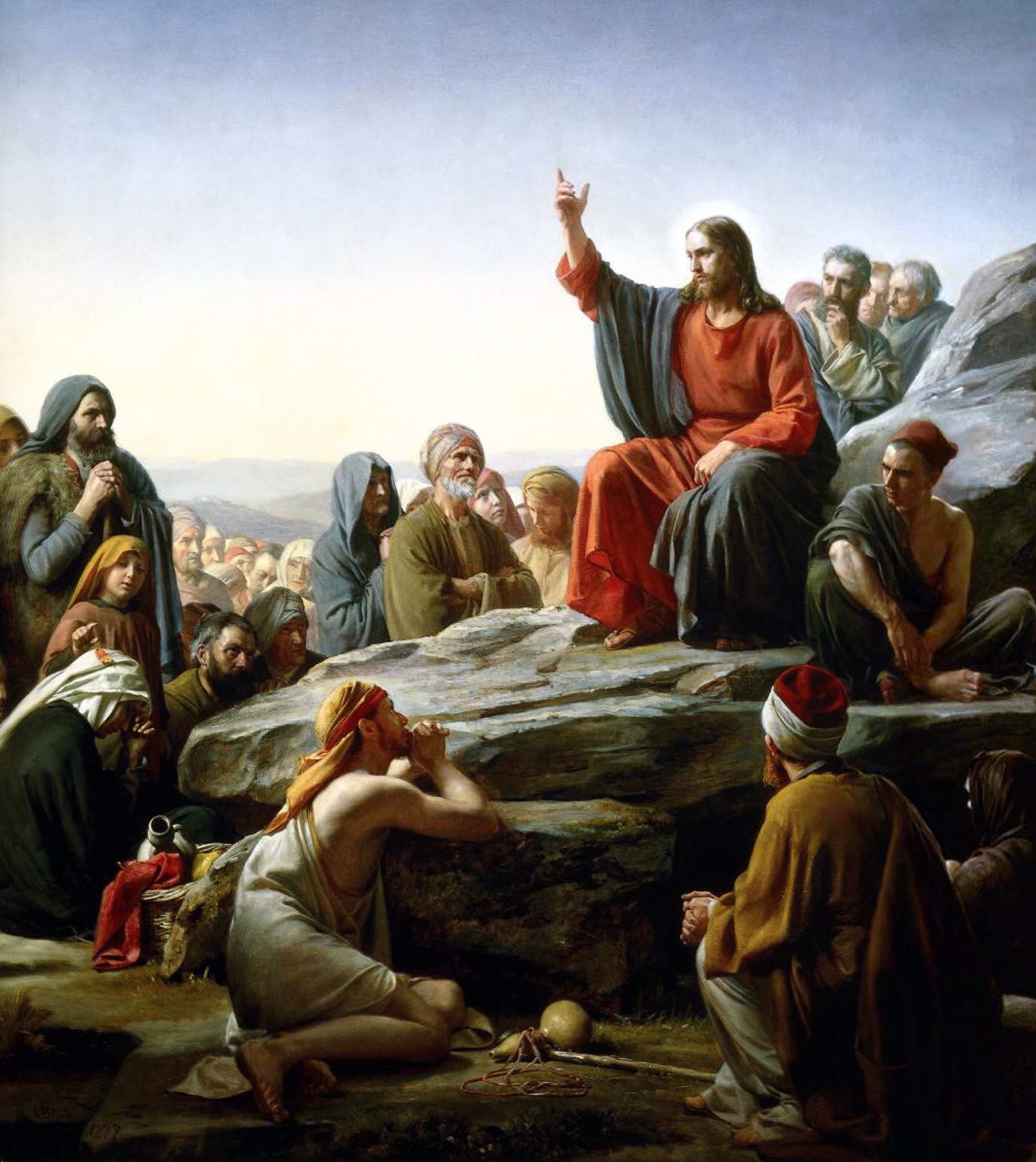
    Image: Carl Bloch, Public domain, via Wikimedia Commons

    By Nathan Walton and Anastasia Marambos

    What is a good year? Is it, as our modern society would maintain, defined by the pursuit of material benefits (whether wealth, power, or pleasure) and the utmost avoidance of pain and suffering? Or are these mere vanities, and “a striving after wind”? (Eccl 1:17). Is the good year, perhaps, defined by something more enduring, something altogether greater and nobler?

    For a Christian, as a follower and servant of Christ, a good year – and, indeed, a good life – is measured by the extent to which one participates in the good; the highest and ultimate good, He Who is Goodness itself, is God our Lord and Creator, as we learn from St Augustine. And the King in His infinite and benevolent wisdom has devised for us a Divine Law, which He promulgated for our sake. As part of this law we have received, we are told in the Gospel of Matthew that “Blessed are the merciful, for they shall obtain mercy” (Mt 5:7).

    Of all the many places in which humans show mercy, the family home is unique. In the Christian family home, day after day, time after time, seventy times seven, we love, forgive, and provide. Parents are constantly being called upon to feed the hungry and give drink to the thirsty; as they raise their children, they instruct the ignorant, counsel the doubtful, bear wrongs patiently, and forgive all injuries. Together, the family prays for the living and the dead. The very vocation of parents is a vocation of love and mercy.

    It is easy to be selfish in an office; it is easy to be impatient in a traffic jam; it is easy to be irresponsible at a party. Is it just as easy to be selfish, impatient, or irresponsible while attending to the needs of the crying child in the darkness of the night?

    The family is a fruitful field for works of mercy; it is also the teaching ground for mercy. For, before a child learns to speak, he has heard his parents pray for the living and the dead; Almost before a child opens his eyes, he has been the hungry being fed; a few years later, he might help to feed a younger sibling. Indeed, the merciful God Who died on the Cross for sinners, was born into a family, lived in a family, and sanctified the family. No other institution can boast that God blessed it like this.

    As 2025 ends, ask not “how much work have I done?” nor “how much success have I enjoyed?” nor “how much work can I do and how successful can I be in 2026?”; rather, slowly read Matthew 5. For the family which has prayed together, forgiven each other, and come closer to God this year, I say unhesitatingly that 2025 has been a very good year indeed.

  • “A Search for the Truth”- Fr. Philip, CSJ

    “A Search for the Truth”- Fr. Philip, CSJ

    Fr. Philip is a priest from the Community of St John, and among the brothers assigned to the Holy Family Parish, Christchurch West. Despite an extremely busy schedule, the brothers make time for daily study, which is an important part of their vocation. Fr. Philip shares his love of study, and explains why it cultivates a relationship with God.

    Christ said, “I am the way, and the truth, and the life;” (John 14:6) This is why intellectual formation is such a vital aspect of Brothers of St. John’s charism; Fr. Philip explains, “we have a robust search for the truth, and a search for the truth is ultimately a search for God.” The purpose of study is “to conform our minds and our hearts with the truth.” Study is one of the four pillars of their order, along with prayer, apostolic mission, and fraternal life.

    This “fervent and robust search for the truth…implies a philosophy,” and this philosophy “would be really seeking out who the human person is, the big questions of life, and grounding that in a realistic view of the person and reality.” This is why Aristotle and Aquinas are so excellent. “A good philosophy helps us to a good and precise and robust Theology; and Theology helps us to contemplate God.”

    Fr Philip explains that while philosophy and theology “will nourish our prayer life, the life of study also has implications for the apostolic life; we are able to give what we’ve contemplated, and we hope that it also nourishes our fraternal life in which we search together and grow together as brothers.”

    Asked whether this was important for the laity, Fr. Philip replied, “100 percent. Those four pillars are human pillars. It’s for everybody. We’re made for community. Everyone is called to prayer. Every Christian is called to be an evangelizer, to use their gifts and talents to build the kingdom of God. Every human is meant to develop and grow into virtue, especially those highest virtues which have to do with the mind and the heart. Intelligence is made for truth, so that is something to realize that potential of the mind, and that’s what virtue is, realizing the potential of the mind to attain truth. In that sense too, everybody’s got a unique path in their intellectual life and their life of study, it’s going to be very individual, but there are ways that are better than others insofar as they help us to stay grounded, using our reason in ways that are aligned with holiness, virtue, friendship.”

    I asked Fr. Philip if he had any book or resource recommendations, specifically for busy parents with five minutes at the end of the day. He quoted St. Paul, “whatever is true, whatever is honorable, whatever is just, whatever is pure, whatever is lovely, whatever is gracious, if there is any excellence, if there is anything worthy of praise, think about these things.” (Philippians 4:8) and explained, “what you fill your mind with, where your heart is going, that is what is going to influence, condition and ultimately make you who you are. So you want to pursue truth and goodness and excellence.”

    There is a lot of published work out there; on the one hand, there is “anti-truth, anti-goodness, gossip, sin, fake news, et cetera”; then, there are things that might not necessarily be false, but tend to be merely informative, rather than formative. One step up, there are resources that present truth; these are “the line of goodness truth, beauty, excellence”. Finally, there is “one step further, drinking straight from the source, and that you will never waste your time on,” for example, Catechism, Contemplative Prayer, Scripture, and the Sacraments, and works of mercy; in these, one is “receiving right from the source of grace.”

    Fr. Philip explained that “the mind is made for truth, the heart is made for goodness.” These sources nourish the mind and the heart. He uses the analogy of a river. One might struggle to jump straight into reading the Catechism for hours, especially if one is not used to that level of reading. Instead, one can find other sources that are still truth-filled, but perhaps easier to read; these are like streams, which lead into rivers, which “lead to the great ocean of God and his love and his mercy.”

    He recommends authors such as Fr. Jacques Philippe, George McDonald, C. S. Lewis, and J.R.R. Tolkien. He also stresses the importance of Lectio Divina, “the prayerful reading of scripture,” even if only for a few minutes a day, as well as podcasts, such as Bible in a Year.

    If parents love the sources of goodness, truth, and beauty, “that will then naturally pass on to the kids”; Fr. Philip recommends that parents, “keep honing your experience and knowledge to make it relevant to the children at whatever age or developmental level they’re at…it’ll be for the parent to see what will help most connect with their kids, and I think it’s important for the parents to enjoy, to have fun with it, and to learn as they go.”

    Children especially learn through “good literature that nourishes the imagination;” Fr. Philip emphasizes “the importance of story, fantasy, and imagination…it is especially crucial in our age that the children are receiving a good formation, and stories are very powerful. That is how God has made the human mind to receive truth.”

  • Catechesis of the Good Shepherd

    Catechesis of the Good Shepherd

    Katherine talks about Catechesis of the Good Shepherd sessions.

    Tell me a bit about your experience with Catechesis of the Good Shepherd.

    I was living in Sydney. I was a nanny at the time, and became interested in Montessori because the child I was looking after went to a Montessori Preschool. A mum I knew from church was a catechist, and when she heard I was interested in Montessori she told me about Catechesis of the Good Shepherd and invited me to observe a session. So nine years ago, I went along, and I was really taken by the peacefulness of the environment, the very natural materials, the independence of the children and just the respect that was shown to these young children. Two weeks later I signed up for a catechists’ course and started training.

    What ages is Catechesis of the Good Shepherd for?

    Level 1 is for ages 3-6, level 2 is for ages 6-9, and level 3 is for ages 9 to 12. The kids move up when they’re ready, and there’s a bit of flexibility.

    What’s different about Catechesis of the Good Shepherd?

    The Montessori method, which underpins Catechesis of the Good Shepherd, is a teaching and learning style. Catechesis of the Good Shepherd is based on the Montessori understanding of the developmental stages of children and their needs, and uses a lot of physical and natural materials.

    Catechesis of the Good Shepherd is really about facilitating an environment where a child can build their relationship with Christ. We’re supporting the family, not trying to teach every aspect of the faith.

    What does a typical session look like?

    The children come for a two hour session every week during the school term.

    The children arrive, and we usually begin by presenting a new work to groups of children, or one on one depending on their need and developmental stage. Some children may go and choose their own work and be presented to later in the session. We don’t use the term play in a Montessori environment, we talk about work. Majority of the time is then spent by the children choosing their own works from the works they’ve been presented. At the end of the session we come together for a short time of communal prayer.

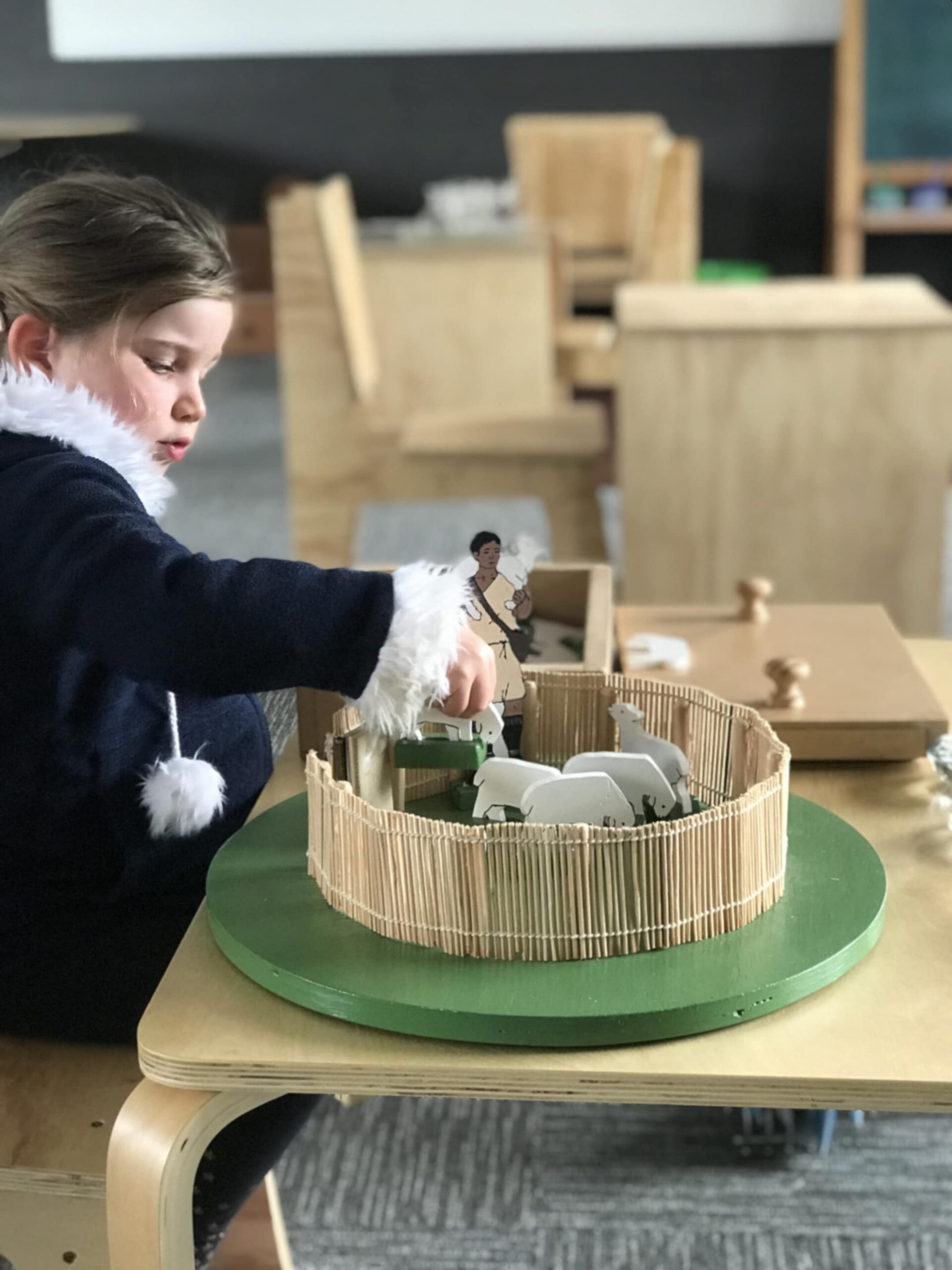
    An example of a scripture work is the parable of the Good Shepherd. When we present from the Bible, we don’t change the language, we read it as it is and then act out the parable with a little wooden shepherd, wooden sheep, and little wooden sheepfold. We then break open the scripture using pondering questions. If the children don’t respond we don’t give them all the answers. We ponder it together, and accept that, over time, we’re going to go deeper and deeper in our understanding.

    When they’re 3 we don’t expect them to understand everything about the Good Shepherd parable and we don’t read every verse of the parable to them. Their understanding builds from working with the materials themselves while having the parable read to them. We keep revisiting it and introduce different aspects of it until they’re like 9.

    What’s your favorite thing about Catechesis of the Good Shepherd?

    It’s probably the joy that I see in the children when they’re immersed in what they’re doing. I don’t know what the Holy Spirit’s doing in their hearts, I only get glimpses through their artworks, or through little things they say, or their demeanor. It’s probably those glimpses I get that make me realize it’s worthwhile.

    What’s your advice to parents on teaching their kids about the Faith?

    Do some age-appropriate things. A 3-6 year-old absorbs and learns through touching and moving, and physical interactions. So having some things that they can touch and tangibly feel, like acting out a Bible story with figures while you read it, is really helpful.

    Have a prayer table in the family home, and rather than it being static, allow the children to set it up for communal prayer time with items appropriate to the liturgical season. You could have different liturgical coloured table cloths, a variety of statues or Holy cards to choose from etc. Involve the child; even if they’re 3, they can choose a song.

    Focus on the child’s relationship with Christ.

    For more information about Catechesis of the Good Shepherd see www.cgsusa.org, or contact Katherine Pawson at chch.childrens.atrium@gmail.com .

  • Education must be controlled by a child’s parents

    Education must be controlled by a child’s parents

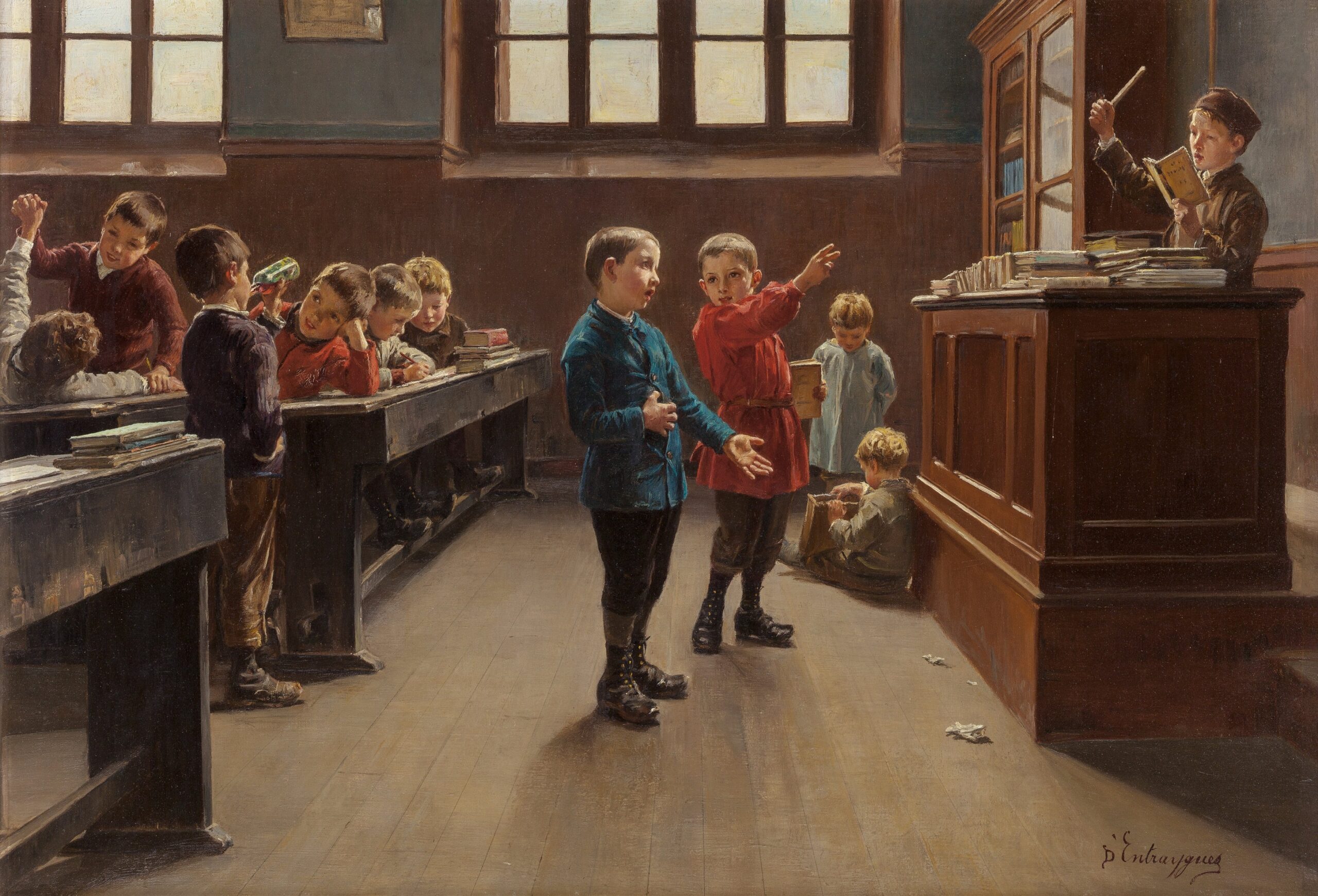
    Image: Charles Bertrand d’Entraygues, Public domain, via Wikimedia Commons

    This article was published by Catholic Culture and is reproduced here with their kind permission.

    By Dr. Jeff Mirus

    One of the great things about the growth of home schooling and various cooperative arrangements is that it puts control of education back into the hands of parents. I don’t mean that it is essential for those who are parents to control the education of children generally. I mean that parents must retain control of the education of their own children.

    This has been reaffirmed many times by the Church, including in the Second Vatican Council’s Declaration on Christian Education (Gravissium Educationis).* While the shift of control of education to the State has made it easier for many parents to “send their children to school”, the increasingly ideological character of education in the modern world has created an Orwellian nightmare of totalitarian and semi-totalitarian indoctrination. In schools throughout the West today, children are continuously “carefully taught” the spiritual and moral equivalent of “black is white and white is black.” In fact, ideological “correctness” is now generally prized above academic quality right through college and graduate school.

    The problem is so serious that it is relatively easy in most modern communities today for parents to do a better and far more wholesome job of educating their own children or at least retaining control over their education through various kinds of independent cooperative efforts. (I know far more about my own country’s situation, but this is certainly true in other places as well.) In America, some locations and some states make this easier than others, but rarely can it be said any longer that home-schooled and cooperatively-schooled children lag behind their peers in public schools. And by the time these students spend a year or two at independent colleges and universities which are unrestricted by federal and state funds, their average intellectual and moral maturity reveals itself to be far higher than the secular norm.

    Through the dominant public methods of education in the United States, in fact, students are most generally taught to think not clearly but ideologically. Both intellectually and morally, such education is a deadly poison.

    Responsibilities and charisms

    I am writing here of the norm. Obviously, in individual cases some parents will do a very poor job of educating their children, just as they will do a very poor job of raising them well at all. But the biggest impediment is the perceived lack of alternatives to the public schools. Whether in the United States or elsewhere, therefore, the Church must play an important role in education—not perhaps primarily through traditional parish and diocesan schools, but especially by raising awareness of and providing spiritual and even material support for home-schooling and what I call cooperative schooling. It is not too much to say that we also need new religious communities to embrace the very Catholic mission of supporting and enhancing home and cooperative school efforts, offering active involvement in these forms of education as well as other kinds of support to struggling families.

    There was a time when it was quite common for new religious communities to devote themselves to the education of orphans and the children of the poor. A revival of authentic religious charisms in the service of enriching home and cooperative educational opportunities may well be just as important now as was the running and staffing of formal parish and diocesan schools just a few generations ago. The Church, of course, has her own obligation to form and educate in the name of Christ Himself, but it is no longer obvious that this obligation is best fulfilled through the restriction of her efforts to Mass, CCD, sacramental formation and formal parochial schools. The time is ripe for each parish to have a Catholic education facilitator on staff who can at the very least orient parishioners to the benefits of home schooling and the possibilities of cooperative schooling in the parish region. Already in the best dioceses of the United States, bishops and Diocesan superintendents of education are becoming engaged with and supporting home schooling and cooperative schooling in their regions.

    These efforts need to be mandated by bishops and expanded through our parishes. The Church may well be able to do far more now through facilitation of parents in the education of their own children than she can do, in many places at least, through the establishment of traditional parish and diocesan schools. The Church is indeed both mater et magistra (mother and teacher), but this does not mean her only or even her best course today is to educate through schools that are simply Catholic versions of the public norms.

    Relatives and friends

    In the 18th and 19th centuries, the Irish often educated their children through illegal arrangements called “hedge schools”, which were located in hedges, ditches, or more often in cabins, houses or barns, and which taught the three Rs and often also Latin and Greek. The parents involved understood that Catholic education was illegal (just as it is disadvantaged by the State in many countries today), and they also understood that they were the primary educators of their children. But then as now, for such home-grown efforts to work, help must come not only from the increasingly beleaguered Catholic Church but also from the relatives and friends of the parents.

    In the regions of the United States in which home-schooling is thriving, there are ever-growing opportunities for what I have been calling cooperative schooling, by which I mean relatively small academic initiatives designed to teach specific subjects, provide common activities for the students, and/or help parents to get the right materials and effective methods for keeping the education of their children on track. But such efforts are mostly in their infancy. Moreover, families with lesser resources and/or two working parents will find it far more difficult to choose this path for the education of their children. This is where parish and diocesan help in various forms can be invaluable, by offering facilities as needed and by providing guidance and even some financial support.

    But this is also where the relatives and friends of those with larger numbers of children can look for ways to be helpful, in everything from financial to actual educational assistance, and definitely not excluding vital levels of moral and spiritual support. It is easier, of course, to drop our children off at what we now think of as traditional schools. But we ought to remember that until the nineteenth century, the vast majority of children were not educated in what we now consider “traditional” schools, and yet intelligence was still on display and children were still able to grow up into well-formed and knowledgeable adults, well-equipped to play productive roles in the social orders in which they found themselves.

    A massive, bureaucratized “educational system” is not necessary to any society. It could even be argued that such a system does more harm than good. In fact that is exactly the point I am making here. Parents must be the primary educators of their children. It is up to the Church and, by extension, all the rest of us, to help make that possible once again today. We must never forget that there is something akin to hunger, thirst, rejection, nakedness, sickness, and imprisonment in the life of the mind and of the soul. Surely our response to such suffering must be clear and generous. For in the end, we know very well what the King will say: “Truly, as you did not do it to one of one of the least of these, you did not do it to me” (cf. Mt 25:31-46).

    And those who failed to help will go away into eternal punishment, but the righteous into eternal life.


    3. The Authors of Education [extract from Vatican II’s Declaration on Christian Education]

    Since parents have given children their life, they are bound by the most serious obligation to educate their offspring and therefore must be recognized as the primary and principal educators.11 This role in education is so important that only with difficulty can it be supplied where it is lacking. Parents are the ones who must create a family atmosphere animated by love and respect for God and man, in which the well-rounded personal and social education of children is fostered. Hence the family is the first school of the social virtues that every society needs. It is particularly in the Christian family, enriched by the grace and office of the sacrament of matrimony, that children should be taught from their early years to have a knowledge of God according to the faith received in Baptism, to worship Him, and to love their neighbor. Here, too, they find their first experience of a wholesome human society and of the Church. Finally, it is through the family that they are gradually led to a companionship with their fellowmen and with the people of God. Let parents, then, recognize the inestimable importance a truly Christian family has for the life and progress of God’s own people.12

    The family which has the primary duty of imparting education needs help of the whole community. In addition therefore, to the rights of parents and others to whom the parents entrust a share in the work of education, certain rights and duties belong indeed to civil society, whose role is to direct what is required for the common temporal good. Its function is to promote the education of youth in many ways, namely: to protect the duties and rights of parents and others who share in education and to give them aid; according to the principle of subsidiarity, when the endeavors of parents and other societies are lacking, to carry out the work of education in accordance with the wishes of the parents; and, moreover, as the common good demands, to build schools and institutions.13

    Finally, in a special way, the duty of educating belongs to the Church, not merely because she must be recognized as a human society capable of educating, but especially because she has the responsibility of announcing the way of salvation to all men, of communicating the life of Christ to those who believe, and, in her unfailing solicitude, of assisting men to be able to come to the fullness of this life.14 The Church is bound as a mother to give to these children of hers an education by which their whole life can be imbued with the spirit of Christ and at the same time do all she can to promote for all peoples the complete perfection of the human person, the good of earthly society and the building of a world that is more human.15

    Source: Mirus, Jeffrey, Education must be controlled by a child’s parents, 2023, Catholic Culture, 2025.
  • “Christ at the Centre” – Helen Alexander

    “Christ at the Centre” – Helen Alexander

    Image: Charles Lock Eastlake, Public domain, via Wikimedia Commons

    Homeschooling Mum Helen Alexander talks about her homeschooling journey.

    Why did you decide to homeschool?

    Our decision to home school came slowly. As a family, we had been moving quite regularly, and needing to settle kids into new schools had made us consider homeschooling at different times. My sister had been homeschooling her children, so it wasn’t a totally new concept. I am a trained primary teacher, so that also meant that I had confidence that I could lead the homeschooling. Some of my concerns were: could I do it with babies/toddlers around? Would my kids get sick of me (and vice versa)?

    In 2018, we were living in Pukekohe. We had seven kids, aged 16 down to 4 years old. Our kids were at the local a High School, the local Catholic primary school and one of the local pre-schools. Life was busy (as with all families!)

    Nick (my husband) and I were trying to figure out how best to live a life with Christ at the centre, how to keep the Faith alive in our family/kids, and how Nick could be around more to support the family in this endeavour. After discernment – which took a while, lots of discussions together and with others, reading books, prayer etc. – we felt motivated to change our circumstances in a big way. We decided that we needed to downsize our debt, live more simply, and spend more time together as a family, and make new routines that put Christ at the centre of our home.

    All of this accumulated into a move from Pukekohe to Picton in early 2019. That’s when we started homeschooling – at the beginning of 2019 before we moved down to the South Island.

    In your family, what does a typical homeschooling day look like?

    The typical day has changed a number of times over the years, depending on the age and stage of the kids, and myself too!

    We generally have a timetable that is visible to all. Each kid has their own schedule. As they get older and more independent, there is some flexibility about timing and order of subjects. I like to keep to a routine because otherwise it’s too easy to get to the end of the day and realize you haven’t got much work done.

    Do you use any curricula? Any resource recommendations?

    I started with the NZ Curriculum, because that’s what I was familiar with as a teacher. Over the years we have tried and tested a number of different curriculum, based on our own research and recommendations from other people.

    At this stage we use mix and match for each of the kids. We use different resources depending on their needs. We do use Angelicum Academy’s Great Books course for our High School kids and Oxrose for some classical courses. We also use IEW, CTC Math online, The Good and the Beautiful Language Arts, Learn Maths Fast, and I pick up different maths, spelling and writing workbooks to supplement where needed.

    Did homeschooling help form your children in the Faith?

    From 2019-2021 we lived in Picton. At the end of 2021, we moved to Leithfield, North Canterbury.

    The big bonus of living where we do now is that we are close to the Beatitudes community. That means our daily life is connected more directly with the life of the Church. We are walking distance to daily Mass and the sacraments, liturgical celebrations and events, retreats, and Faith groups for our girls and boys supported by the Sisters and Priest/Brothers of the Beatitudes Community.

    We would miss much of these things if we were not as flexible as we are with our home schooling lifestyle. It also fulfils our desire to have Christ at the core of our lives.

    What is your favourite thing about homeschooling?

    The thing I most appreciate about home schooling is the privilege of being connected to your kids in a way that is more than an academic education. When we started home schooling, I thought that if by the first holiday break I hadn’t killed anyone, and the kids didn’t want to kill me, then we were probably doing okay!

    But what I found is that, although not every day was easy, it just felt like the right thing for all of us.

    Initially our kids were reluctant to be ‘different’ as homeschool kids. Now they say they will homeschool their kids…I think that means we are doing okay.

    What is the hardest thing about homeschooling?

    The hardest thing about homeschooling is being confident that you are giving your kids what they need and that you, as the teacher, are doing a good job.

    I think too, we need to be careful about comparing ourselves – what we are doing, learning, teaching – with other families. The beauty of homeschooling is that we can meet the needs of our kids in our own way.

    What is one piece of advice you would give to every homeschooling mum?

    Try different approaches/curriculum – but borrow them if you can. It can be very costly to buy your own resources and then find out it doesn’t work well for you or your kids.

    And also, remember, on your ‘not so great’ days, that it’s okay to get in the car and go to the playground, or watch a documentary if needed.

    Do you have any other insights to share about homeschooling?

    Even though I am a trained primary teacher, I have learnt much more about education and learning through being a home school Mum. I think that homeschooling parents should take confidence in the fact that they want the best for their kids and will find a way to provide what they need. They don’t need to be a trained teacher to provide their kids a decent education.

    Since the beginning of our home schooling journey we have moved more towards a liberal arts focused education for our kids. We are not providing a strictly traditional liberal arts education. We incorporate what we can, when we can. Nick has been involved with ‘The Thomas More Society‘ which is helping to bring liberal arts learning experiences to Canterbury. They have run a number of intensive courses for different age groups. They have included experienced liberal arts teachers/lecturers including Ben and Eliza McCabe from the Augustine Academy in Australia, and Dr Paul Morrissey the President of Campion College in Sydney.

    These experiences have opened our family up to the richness and depth of our Catholic teaching traditions. It has been one of the more important aspects of our homeschooling life because it helps to bring Christ into every part of our lives. It means we don’t put our Faith into a compartment in our life – of Sunday Mass or morning prayer – but rather, it can permeate throughout our lives in all we do – well, our best effort to do so, as imperfect as we are.

  • Homeschooler Alumni & Commerce Student: Helene Mischewski

    Homeschooler Alumni & Commerce Student: Helene Mischewski

    Image: Martin Vorel, CC BY-SA 4.0 https://creativecommons.org/licenses/by-sa/4.0, via Wikimedia Commons

    Helene talks about how homeschooling helped her to be involved in the pro-life movement and prepared her for studying a Bachelor of Commerce.

    How long were you homeschooled for?

    I was homeschooled for my whole life.

    What did you do after your homeschooling education?

    After school, I took a gap year so that I could go to World Youth Day in Portugal, and I worked for my Parish, running their coffee van. I prepared for the trip, volunteered at a pregnancy center, and prepared quotes for my brother’s landscaping business, Fresh Start. After the gap year, I went to the University of Canterbury to study a bachelor of commerce majoring in management. I started with a minor in sport, and in the second year I changed that to marketing. I am now working part-time as a nanny, and for Fresh Start.

    Did homeschooling prepare you well for university?

    At uni you do a lot of study on your own. There’s no set schedule, like there is in school. Homeschooling is similar to uni; you have your subjects, but you get to choose where to spend time on them. In my high-school years, I took subjects that gave me university entrance through NCEA or Cambridge. I could choose the topics I wanted, but also how and when to study, which I found was quite useful; picking the subjects that I had a passion for and having personalized choice. 

    You’ve been involved in the Pro-life movement; did homeschooling help with this?

    Having the more flexible schedule allowed me to make time for volunteering, and organize my study around other things I wanted to do. Volunteering at the Pregnancy centre worked around my study schedule; and other volunteering like Voice for Life Youth, which I got to know through a group of homeschool friends. My involvement in public speaking groups though homeschooling meant I could eventually give a talk at March for Life. I used a curriculum that was quite focused on Catholicism and Pro-life movements.

    What did homeschooling look like on a day-to-day basis?

    My usual strategy was to try to get a lot of the work done as early as possible. I’d often get into my work as soon as I got up, and work through it, with small breaks in between. This was broken up by homeschool events or regular sports, and often in the afternoons I would play with siblings, do crafts, play sports, go on hikes, and hang out with friends; I’d try to leave the afternoons and evenings free.

    Did home-schooling help form you in the Faith?

    I think it did; I had a religious education curriculum that was very personalized to my family. Dad would often help us on RE. He would read books aloud to us about apologetics, and we would discuss them as a family over the dinner table. I guess just being around my family a lot meant we had a lot of Faith discussions, and the chance to go to Mass and Adoration – which the flexible schedule helped with.

    Do you have a book/resource recommendation?

    Chief Truths of the Faith.

    When we were primary-school age, we read saints stories and then summarized them back to Mum; she would write them in a scrap book and we would draw a picture to help us remember saints or Bible stories.

    What was your favourite thing about being homeschooled?

    The chance to be around my family so much. I developed a really close bond with all my siblings, which even now, as we move out of home, we’ve always retained. There’s a lot of trust and love between my siblings, which definitely isn’t impossible, but is harder in a school environment. Faith discussions; building each other up; praying for each other; and being around Mum and Dad a lot.

    What was a challenge about being homeschooled?

    A little more limited social opportunities, and also probably slightly less chance to reach out and evangelize, which you can sometimes do more easily in school. These were just small challenges; in general homeschooling was really awesome, and my family was really good at integrating all these things together.

    Do you have a study tip?

    Make your study time intentional. I know it can be easy to get distracted when you’re studying and not get everything done. If you have really dedicated study time, then you have more time for everything else. If you make your study time intentional it makes the rest of your time more enjoyable.

  • Homeschooling in the Faith

    Homeschooling in the Faith

    Image: Aulnoy, Madame d’ (Marie-Catherine), Public domain, via Wikimedia Commons

    An interview with an amazing homeschooling mum. Anonymous.

    Why did you choose to homeschool?

    The sex-education in schools – too much information for little people! I thought “I don’t want my littlies to have their innocence taken away sooner than it has to be, thank you!”

    Faith. I could see the trends; so many children were losing their faith and I wanted my children to keep their faith.

    And I wanted to like my children, and I wanted my children to like each other and to get on. I didn’t want to be a parent that said “I’m so glad my kiddies have gone to school today; oh no the holidays are coming on.” I didn’t want to have that kind of thinking.

    What did homeschooling look like for you on a day-to-day basis?

    I can freely admit I wasn’t a very good homeschool teacher for a start off, because I had no teaching background. I just went with the principle that generally any kind of teaching was better than being at school, and most mothers could manage it [homeschooling]. I went with that. Over time I found it wasn’t that simple, and it was much harder than I thought it was!

    I did try a variety of curricula. In terms of the children learning their Faith, one book we used was Christ the King, Lord of History. And Seton, I wanted to go down that path too, but that became too hard and to expensive. The other one was Saxon math. I used a few others ones. In the way of science we didn’t get a lot achieved. We did quite a lot of activities outside of home.

    What did socialization look like for your family?

    We spent so much time socializing we had to reign ourselves in and come back and do some paperwork!

    Soccer, swimming, ballroom dancing, cycling, gym. Quite a lot of music. Junior choir, flute, piano, violin, sewing, and basketball.

    How did you bring the Faith into your day-to-day life?

    It was the rosary, really. Going to Mass, and learning about the Traditional Mass. Then Stations of the Cross, and adoration.

    What was the best thing about homeschooling?

    Watching the children grow in their Faith. And also their singing.

    I had said a prayer to Jesus one time when we were at Mass in the Cathedral. I said to our Lord, “if they can only use their voices to praise you and to honor you, then it’ll all be worthwhile,” and indeed that became the case. God really heard that prayer.

    What was the hardest thing about homeschooling?

    Getting the paperwork done, getting the schoolwork done, and figuring out what they needed for their future.

    What advice would you give to other homeschooling mums?

    If you have to pay for tutors, pay for tutors.

    The children need both religion and education.

    Pay attention and encourage them in their strengths!

  • How & Why to Learn Theology; Dr. Peter Christofides

    How & Why to Learn Theology; Dr. Peter Christofides

    Image: Alvesgaspar, CC BY-SA 4.0 https://creativecommons.org/licenses/by-sa/4.0, via Wikimedia Commons

    Watch the full interview here!

    Peter Christofides, Theology lecturer and undergraduate degree coordinater at Notre Dame University, shares his love for Theology, and talks about ways to learn it.

    Peter grew up in Johannesburg; after two years of military service, he tried studying law, but “realized that my calling was to study Theology.” After completing his Bachelor of Theology, he worked with kids from the streets of Johannesburg, and in school. He then completed an honors and masters in Theology, and a Phd in peace and reconciliation. Then, as a lecturer, he completed a second PhD, on the rediscovery of the role of the laity in the mission of the Church. He says, “Rather than me running after Theology, it seemed like Theology came after me, and I’m constantly improving myself with short courses, and obviously as a lecturer there’s constant preparation. So that is how, I suppose, Theology found me rather than me finding Theology.”

    Asked about whether Theology gets people jobs, Peter says, “There are so many vocations for people who do a bachelor of Theology.” You can study Theology along with another discipline, such as philosophy or law. “We live in a world where ethics seems to be out the window,” and Theology studies can enable a person to work in ethics for any organization. Peter mentioned, “I was invited to the human research ethics committee for the health department of western Australia, just to be the ethical voice for the organization. So when people want to do experiments, what is the ethical side of things?” There are also many opportunities to work in chaplaincy.

    Theology “is not just for those who want to become priests or nuns, there are many, many different vocations that are available, and I think companies are looking for more people to be involved from an ethical perspective…just to understand the standard of ethics from a moral perspective.”

    Peter lectures in Perth for CFE, (Center for Faith Enrichment); each school term, he goes to a different parish and gives a series of lectures. People can attend these for their own interest and personal formation; or, by doing four courses through the CFE, with assessments, and four through the university of Notre Dame, they can achieve an Undergraduate Diploma in Theology. Another way to grow in Theology is to have a group which meets regularly to read and discuss the Bible.

    On teaching Theology in the family, Peter says, “It’s difficult to teach children if you don’t know the topic yourself.” Having good personal formation can helps you, as a parent, to give your children a solid grounding in the Faith. In the Christofides family, Theology “becomes part of our family talk”; rather than setting aside a specific time to formally talk about Theology, it becomes part of the everyday dinner table discussion; “It’s part of how we roll as a family, if you like.”

    Having a strong academic background in Theology also helps one’s own Faith formation; for example, Peter knows Biblical Greek, and so he can listen to the Gospel at Church, and then read the same passage in its original language, which adds a whole layer of meaning.

    There are so many ways to learn Theology; Peter said to me, “There is so much available, Anastasia; free literature online that is available to help us to grow, and increase in our faith as followers of Jesus.”

    Watch the Interview

  • Inspiring Quotes on Education

    Inspiring Quotes on Education

    Image: Jean-Paul Louis Martin des Amoignes, Public domain, via Wikimedia Commons

    “Train up a child in the way he should go, and even when he is old he will not depart from it.” – Proverbs 22:6

    “The home is the first school of Christian life.” 1657, Catechism of the Catholic Church.

    “Without education, we are in a horrible and deadly danger of taking educated people seriously.” – G.K. Chesterton

    “The most gifted minds, when they are ill-educated, become pre-eminently bad.” – Plato, The Republic

    “Parents have the first responsibility for the education of their children. They bear witness to this responsibility first by creating a home where tenderness, forgiveness, respect, fidelity, and disinterested service are the rule. The home is well suited for education in the virtues.” 2223, Catechism of the Catholic Church

    “Keep hold of instruction, do not let go; guard her, for she is your life.” – Proverbs 4:13

    “Education consists essentially in preparing man for what he must be and for what he must do here below, in order to attain the sublime end for which he was created.” Pope Pius XI, Divini Illius Magistri

  • Raising Defenders of Life

    Raising Defenders of Life

    Image: CalebJones2003, CC BY-SA 4.0 https://creativecommons.org/licenses/by-sa/4.0, via Wikimedia Commons

    By Anastasia Marambos

    The Angel Gabriel said to Mary; “you will conceive in your womb and bear a son, and you shall call his name Jesus.” (Luke 1:31) Our God and King and Savior dwelt for nine months in the sanctuary of Mary’s womb. Then, for His dwelling place for thirty years, Christ chose a family.

    A Christian family welcomes children, cares for them, and nurtures them. Thus, for families to flourish is the aim of the pro-life movement. Families are also the foundation of all pro-life institutions, for nobody can advocate for the unborn unless they have first been born.

    Pope St. John-Paul II wrote, “Life is always a good. This is an instinctive perception and a fact of experience, and man is called to grasp the profound reason why this is so.” (Evangelium Vitae, 34) It is in the family that new life is welcomed; in the family, a child first appreciates the profound goodness of human life.

    Pope Leo XIV, then Cardinal Prevost, said “God’s mercy calls us to protect every life, especially those society overlooks—the child yet to be born and the elderly nearing their journey’s end—because each bears Christ’s face.” (Homily, Suburbicarian Diocese of Albano, 2025) In the Christian family, the most helpless ones are cherished, for “as you did it to one of these the least of my brethren, you did it to me.” (Mtt 25:40)

    Pope Pius XI wrote, “the family is more sacred than the State and…men are begotten not for the earth and for time, but for Heaven and eternity.” (Casti Connubii, 69) The U.S. branches of government, legislative, judiciary, and executive, reflect the task of government to make, apply, and enforce laws; the task of the family is to “raise up fellow-citizens of the Saints, and members of God’s household.” (Eph. 2:19; Casti Connubii, 13)

    No wonder, in the modern world, the family is under attack! The Evil One has good reason to fear the family, for it is in the family that saints are raised.

    The Catechism says, “In our own time, in a world often alien and even hostile to faith, believing families are of primary importance as centers of living, radiant faith.” (CCC, 1656)

    By welcoming children and educating them in the Faith, by frequently approaching God through prayer and the sacraments, and by imitating the Holy Family, families can counteract the culture of death.

    I am blessed to be the eldest of ten in a Catholic homeschooling family. I grew up surrounded by children. I have early memories of looking at the picture of an unborn baby sibling on an ultrasound scan and witnessing the undeniable humanity of this beautiful person. I vividly remember when mum gave us the joyful news that “I’m having a baby,” and that was a baby, my younger sibling, not a collection of cells. In less than a year, we welcomed that baby into our home, held him in our arms, and gave thanks to God for the blessing.

    My family taught me that people, no matter how small, are worth sacrificing for. You always sacrifice something in a large family – whether that be the last chocolate chip cookie in the jar because somebody got there first, or hours of your day because someone is sick and needs looking after. However, this is not a con; this is a pro, because you find so much joy in helping this beautiful person that God has put into your life.

    I don’t think anyone can ever fully comprehend how tragic abortion is, or fully understand the immeasurable value of a human being. However, learning from a young age that every human being is a child of God, redeemed by Christ, definitely helps.

    Personally, I was really inspired by growing up surrounded by life and Faith. This has motivated me in every pro-life activity I’ve been involved in, whether crocheting baby blankets for a pregnancy center, learning about defending life in a culture of death, or organizing prayer vigils for the unborn.

    By welcoming your children into the world and raising them in the Faith, you are already doing something intrinsically pro-life. To raise a child Catholic is to raise them pro-life, because we know that God became an unborn baby.

    Here are some ideas for pro-life activities you can do as a family:

    – add “all unborn babies and their parents” to your prayer intention list for your daily rosary.

    – pray to St. Gerard Majella and St. Gianna Molla, patrons of mothers and unborn babies.

    – pray the Spiritual Adoption prayer of Venerable Fulton Sheen.

    – pray the litany to Jesus in the Womb of Mary.

    – attend March for Life.

    – donate clothes to a pregnancy center.

    Prayer is immensely powerful for the pro-life movement – because it asks the help of the God Who loves unborn babies; the unborn are created by God and Christ died to redeem them. And “with God, nothing will be impossible.” (Luke 1:37)

  • The family: Not for production or consumption, but joy

    The family: Not for production or consumption, but joy

    Image: Ferdinand Georg Waldmüller, Public domain, via Wikimedia Commons

    This article was published by Catholic Culture and is reproduced here with their kind permission.

    By Dr. Jeff Mirus

    In his comments on industrial accidents on March 9th, Pope Francis mentioned that “the clear separation of family and work environments has had negative consequences not only on the family, but also on the work culture.” The Holy Father made the point that the sharp separation between the two has reinforced the idea that the family is the place of consumption and the enterprise the place of production.

    This observation is right on target. In a rural economy of small farmers, for example, the family flourished in an atmosphere of shared responsibilities and benefits which encompassed the whole of life—a life more often than not rooted in prayer for what God alone could control (such as the weather) and lived out through hard work and shared leisure in a deeply familial setting. If we compare this pattern with that of an industrial society, we find intense pressures in precisely the opposite direction.

    In the society of factories and offices, for example, it is necessary to separate parents and children for the bulk of most days, as well as separating spouses from each other. This was mitigated during a period of single income families, but only through the familial marginalization of fathers. Still, it was the rise of industrialization that led to the regimentation of widespread public education, taking the children out of the home from an early age, and eventually separating the father (in most cases) as primary producer from the mother and children as, in effect, consumers. While it is difficult to respond effectively to widespread socio-economic trends, it is clear enough that over the past two hundred and fifty years not only was the family essentially restructured owing to economic shifts but also the human sense of satisfaction, pride and power came to be increasingly linked to what we might call the world of business.

    The family became increasingly subordinated to an engine of material progress which operated not only independently of the home, but in a very real sense in an unequal competition with the home. Worse still, as businesses became larger and larger (even to spanning the globe), job transfers proliferated. Once again the family was subordinated to commercial interests, human “roots” ceased to have significant meaning in the history of families and close-knit communities, modern men, women and children increasingly became atomized individuals who bounced from place to place and situation to situation throughout their lives. Given the context, which was usually portrayed as offering “superior opportunities”, it is no wonder that the sins of an uprooted individualism—including divorce, psychologically damaged children, and the drive to find one distorted private satisfaction after another—became a way of life.

    Of course, the problems, temptations and sins characteristic of the human person are present in every era and under every circumstance. Nonetheless, it is clear that societies and their economic engines can be organized more or less beneficially for the life of the family. When this develops in less beneficial ways, we end up with widespread personal instability and distress, the normalization of many individualized forms of immorality, the decline of the family and close-knit societies, and the consequent loss of natural communities of support. Another result is that a great many people regard family life as the cause of most of their problems, and so they continue their flight from it.

    But what has really been the cause, in the vast majority of cases, is the more or less deliberate evisceration of family life.

    The Future

    One of the benefits of the COVID epidemic was to demonstrate that the prevailing model of work outside the home was anything but economically necessary for huge numbers of people. Granted that massive factories are still considered economically necessary, there is still an ever-increasing likelihood that even many of those who depend ultimately on machinery can find ways to fulfill their “modern utility quotient” at home—and that children can learn at home, or at least in smaller, more parent-centric schools that are not mere ideological hives of the State—and that parents and children alike can find the resulting increased interaction among all family members to be a delightful change. Interdependence and mutual support increase as relationships deepen. Love grows, and with it the most fundamental personal and social stability known to humankind.

    The family can become once again the primary community of human persons, essential and deeply beneficial to each member, out of which blossoms an intentionally more personal and supportive social order. Of course, our current larger social order—dominated as it is by the spiritually and psychologically injured—will continue to exert a corrupting imperial influence over everything. It is more than likely that, as genuine happiness continues to elude the leaders of the dominant culture, these leaders will seek through ever more draconian methods to eliminate the witnesses against their values, whom they will blame instinctively for interfering with happiness.

    But they will remain unhappy, and the startling truth is that those they most abhor will remain joyful even in the midst of any imposed suffering. These, in the long run, are fruitful circumstances for evangelization. But we must all look around, if we have not done so already, to see how the new economic normal can be used once again to serve family life, until the family becomes (to use a shameful vocabulary) the center of “production”. I mean the formation of persons.

    We ought to know by now that human happiness runs through and arises from families, both naturally and supernaturally in Christ. Not all of us have equal opportunities. Even some of us who work at home may be known to hole up at our desks without sufficiently participating in the family dynamic. Life is full of balance problems, which we all must constantly address. Nor will the most common possibilities for a renewed family life apply to everyone equally. It is far easier to be family-centric in some lines of work than in others; it is even far easier to strip back to a single income in some lines of work than in others. But to the best of our ability, we must make life family-centric again. And we must architect a society which frees not so much the individual as the family to make good on its Divinely constituted purpose and genius.

    The Holy Father is right about this. The family is not an unfortunate locus of consumption in a world dominated by the demands of productivity. Still less is the family a mere convenience to be continually restructured according to selfish demands. The family is the locus of life. The family is where human persons flourish. The healthy family has been created to spread peace and stability and happiness through a river of love. Anyone—from the most obscure contemplative to the mightiest politician, from the policeman on the street to the actor on the screen, from the factory worker to the knowledge worker, from the planted field to the polished board room—anyone who is not striving directly or indirectly to serve the good of the family is simply not striving to serve at all.

    About the author: Jeffrey Mirus holds a Ph.D. in intellectual history from Princeton University. A co-founder of Christendom College, he also pioneered Catholic Internet services. He is the founder of Trinity Communications and CatholicCulture.org.

    Source: Mirus, Jeffrey, The family: Not for production or consumption, but joy, 2023, Catholic Culture, 2025.
  • Catholic Family NZ

    Catholic Family NZ

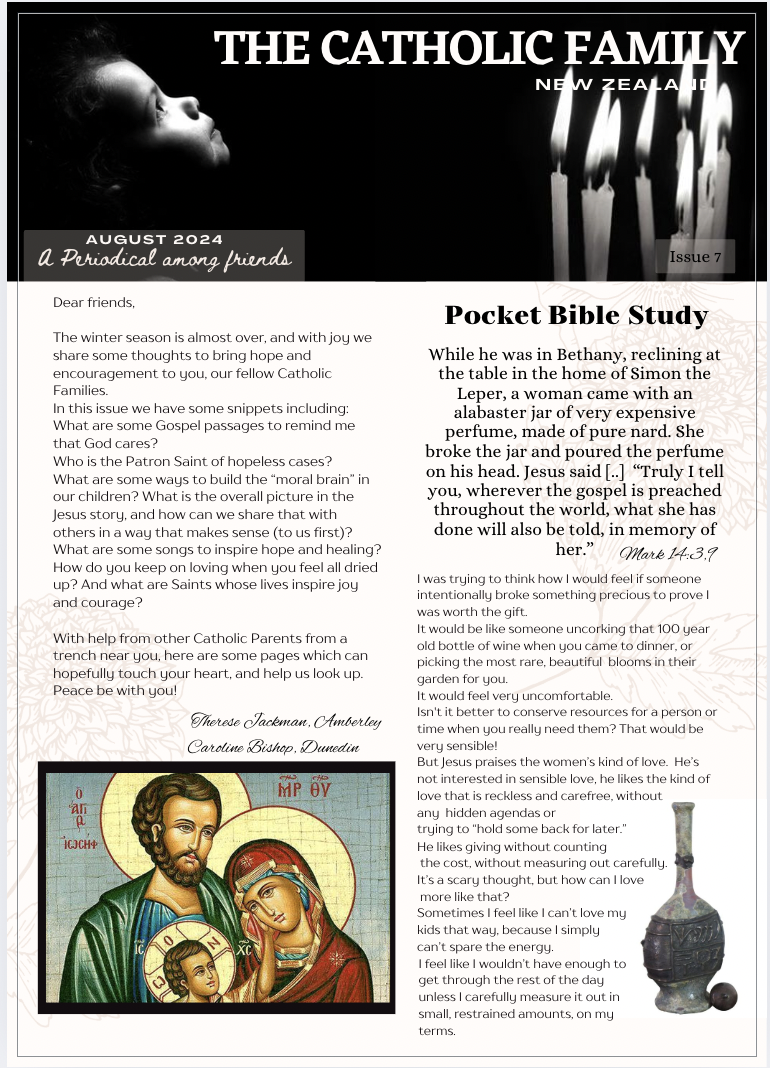
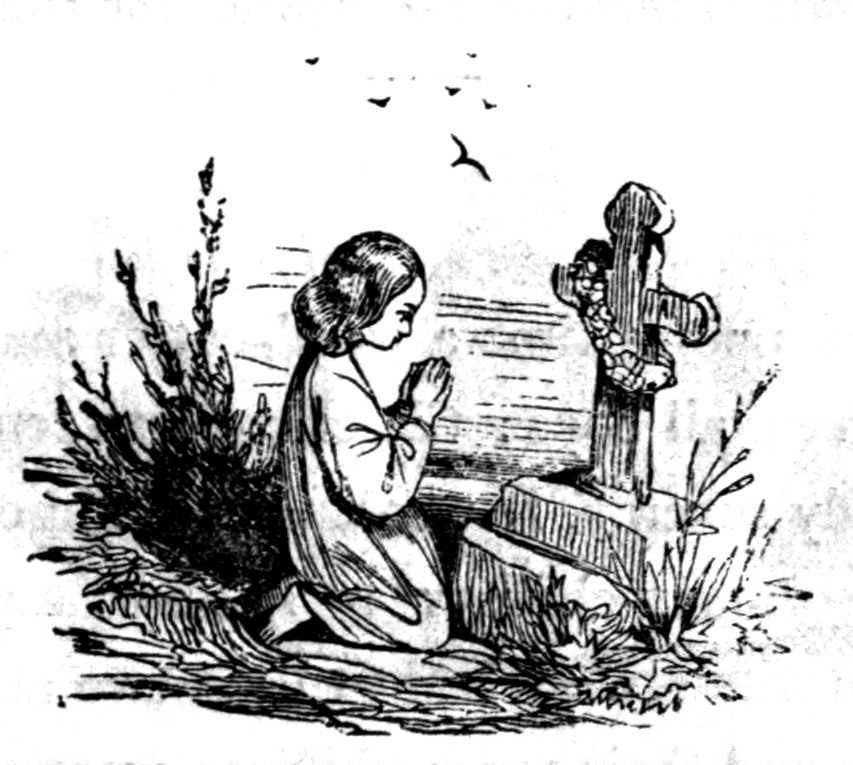
    Image: Front page of Catholic Family NZ newsletter.

    Recently, I visited a lovely young Catholic family; I had lots of fun making play-dough snowmen with Esther (age 5), Dominic (age 3), and Louis (age 2), while talking to their mum, Therese, about Catholic Family NZ. Geared (as the name suggests) for Catholic families living in New Zealand, it is a quarterly newsletter including inspiring stories, testimonies, fun quotes, and more. Therese has been running this since 2021.

    Therese says:

    The desire for this little family periodical is to – in the spirit of St Paul, “encourage one another, and build one another up.” (1 Thess. 5:11) Life as Catholic parents is hard and often lonely, as often no one sees the real and daily struggles in the hidden little Mission fields of our homes. The call of the Gospel sets before us a beautiful but often very challenging ideal, of laying down our life like “a grain of wheat” (John 12:23) and living with the trust of a little sparrow in the hands of our Heavenly Father, even when the pressures of life are often relentless and exhausting. Our hope is that these small pages can bring some companionship on the journey towards holiness; with some light and hope from fellow pilgrims, who though they may be geographically far away, are walking exactly the same path, every day.

    If you are living in New Zealand, you can sign up for the Catholic Family NZ newsletter by contacting: Catholicfamilynz@gmail.com

  • Flying on Eagles’ Wings

    Flying on Eagles’ Wings

    Image: Eagles Wings’ directors. Image courtesy of Donna Allen.

    In October of 2021, Donna Allen and Kaelih Peaty started Eagles’ Wings to help meet the need for authentic Catholic Education. Donna was a schoolteacher and Head of Department for twenty-eight years before stepping away from her job due to conscientious objections as did her eldest daughter, Kaelih, who was a talented Primary school teacher at the time. As Donna’s mother was also a high school teacher, they combined their collective teaching experience as a family to start Eagles’ Wings Education; a homeschool tutoring support service which provides some classroom-like benefits, such as learning from experts, learning in groups and like-minded socialisation with a level of flexibility and guidance that is impossible in a school setting.

    Eagles’ Wings currently operates venues in New South Wales, Winston Hills, St Mary’s and Moorebank. It provides one-on-one tutoring, group classes, and support for homeschooling parents. It gives parents time to catch up on housework or go on retreat, while still allowing them to be the primary educators of their children. It also enables parents to socialize and support one another. Built to cater to large families, Eagles’ Wings offers discounts to children who have siblings already enrolled in classes and Catechism lessons are free. The Waitlist page on their website allows families who live in different areas to express interest and form groups in all areas of NSW. Then, when there is enough committed interest Eagles’ Wings can then facilitate a new vibrant local experience.

    Donna wrote about her journey founding Eagles Wings here. She says, “I wanted to create a service that every parent could use, especially ones who have never considered home-schooling before, and so that they could have their eyes opened to believe that they could. I wanted a place that children could enjoy, parents would appreciate and where teachers (now acting as tutors) could fulfil their vocations.”

  • “I loved being at home” Anna Hill

    “I loved being at home” Anna Hill

    Image Credit: NASA, Public domain, via Wikimedia Commons

    (I picked this image because Anna loves to surf)

    Homeschooled from Kindergarten to year 10, Anna says, “I loved it, it was a lot of fun. I loved being at home.” Anna has ten siblings, and says, “it was fun to have a group of us at home.” All her siblings have been homeschooled for part of their education.

    Anna’s favourite thing about homeschooling was “having the freedom of choosing your own thing…and having that one-on-one time with your teacher, which is my mum, to…help you overcome difficulties that you’re facing, or improve on your good qualities.”

    History was Anna’s favorite subject, but she also enjoyed English, and science in primary school. Anna talks about how homeschooling prepared her for the university studies she is doing now at Campion; “in homeschooling…we [studied] ancient history, like classical history, which is what we’re learning at Campion.”

    Anna went to school for a short time, and says “the school life was a big change.” She says it was “good for socialization,” but often she spent a lot of time at school learning things she’d already learned, or learning things that “at homeschooling we could have just gone through quicker.”

    After a term or two of school, COVID happened, and Anna was studying at home again. Anna says, “It was a surprise, but…I liked being at home. When you’re doing online school, it’s at your own pace, in a way, so I liked that part of it…I also did like going to school and seeing people every day.”

    Anna says “a lot of our homeschooling subjects were focused on the Faith,” and mentions learning Catholic history and reading Catholic literature, which “really helped me grow in Faith.” It was also great to have a good grounding in the Faith when she went into the school environment.

    On extracurriculars and social life, Anna said “I’ve grown up in a small town, so I think that really helped with my social life…knowing all the other families in the town and doing sports within the town.” She mentioned that “there’s definitely a point in school, where you do a lot of different sports and stuff that you don’t normally do at home.” Anna enjoys sports and has “done lots of different sports, so surfing, swimming, netball, touch football, soccer,” and also “drama, we did musicals and stuff,…music, we did piano, and little bit of guitar as well.”

    Anna gave a study tip for homeschoolers; “if you’re struggling, if you’re stuck on something which you can’t push past…focus more on those kind of things, grow with your understanding of those things which you’re struggling with.”